Easy-to-understand health information
rheumatoid arthritis
An autoimmune condition causing joint-lining inflammation, often symmetrically. Early treatment helps limit permanent damage.
Summary before reading further
What is this topic, and why does it matter?
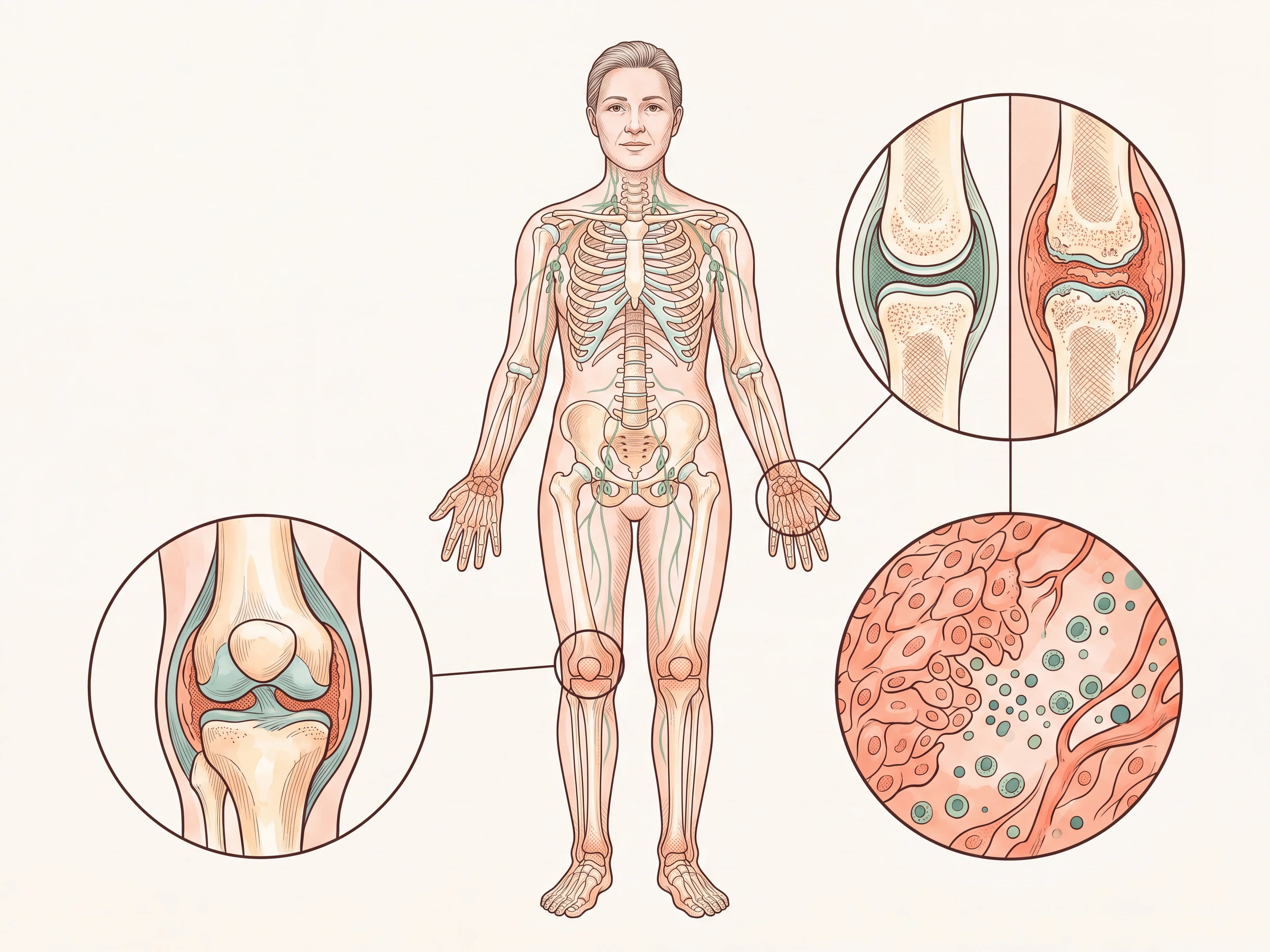
Rheumatoid arthritis differs from osteoarthritis because the immune system attacks the joint lining, causing pain, swelling, warmth, and stiffness. It often begins in the small joints of the hands, wrists, or feet. Morning stiffness usually lasts longer than stiffness after brief inactivity.
The condition can also affect the eyes, lungs, heart, and blood vessels and cause fatigue or a low-grade fever. Diagnosis combines symptoms, joint examination, blood tests, and imaging. Do not wait for joint deformity before seeking care.
Health glossary
- Rheumatoid factor and anti-CCP
- Blood tests that support a rheumatoid arthritis diagnosis. Positive or negative results alone cannot confirm or exclude it.
- CT and MRI
- CT uses X-rays, while MRI uses magnetic fields and radio waves. The choice depends on the organ and clinical question.
What happens in the body?
Explain the mechanism step by step.
Swelling in several small joints and prolonged morning stiffness are characteristic, but diagnosis combines the pattern, joint examination, blood tests, and imaging. Early disease-modifying treatment can limit permanent damage.
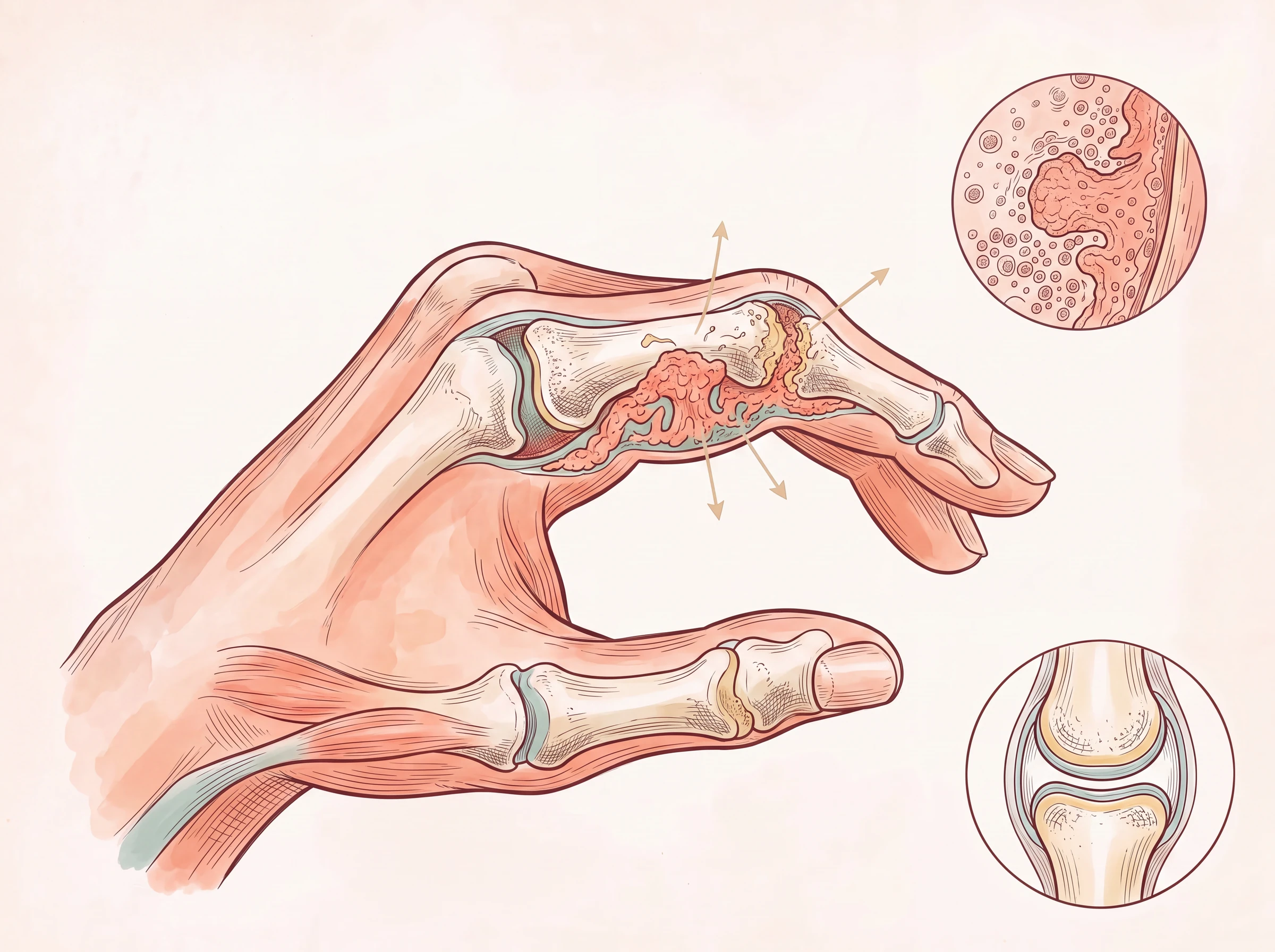
Immune activity inflames the joint lining.
Cells and inflammatory substances accumulate in the synovium.
Thickened, inflamed joint lining forms a pannus.
Inflamed joint lining invades cartilage and adjacent bone.
Deformity if inflammation lasts for a long time
Cartilage thins, bone erodes, and tendon alignment is disrupted.
Values or criteria that you should know
Aim for remission, not simply tolerating pain.
Rheumatoid arthritis monitoring considers swollen joints, symptoms, inflammation, and function because pain has several possible causes.
Morning stiffness
How long morning stiffness takes to ease after waking.
- Reference range
- Brief stiffness without swelling may occur in other conditions.
- You should make an appointment for an evaluation.
- Morning stiffness longer than about 30–60 minutes with symmetrical small-joint swelling warrants assessment for inflammatory arthritis.
- Should be evaluated urgently
- A very hot, red joint with fever needs same-day assessment to exclude joint infection.
DAS28
A disease activity score based on 28 joints, blood tests, and clinical assessment.
- Reference range
- For this score, below 2.6 indicates remission and 3.2 or lower indicates low disease activity.
- You should make an appointment for an evaluation.
- DAS28 above 5.1 indicates high disease activity and warrants review with your doctor.
- Should be evaluated urgently
- The care team should calculate this score. Do not use it to stop immunosuppressants yourself.
Causes · Symptoms · Examination · Care
See important information in one place.
Causes and related factors
- genetics and female gender
- Smoking and gum disease are associated with risk.
- Environmental factors interact with immune processes; ordinary use of the joints is not the cause.
Common symptoms
- Swollen small joints in both hands or feet.
- Prolonged morning stiffness, fatigue, or low-grade fever.
- The eyes, lungs, skin, and blood vessels may be affected in some cases.
How do doctors check?
- Assess swollen and tender joints and symptom duration.
- Check ESR/CRP, rheumatoid factor and anti-CCP.
- Ultrasound, X-ray, or MRI to assess inflammation and damage.
Start taking care of it systematically.
- See a rheumatologist promptly for persistent joint swelling.
- Use disease control medicine as planned and have blood tests as scheduled.
- Practise range-of-motion and strengthening exercises, adjusting during flare-ups.
Important things you should know
Keep these points in mind.
Early treatment helps maintain joint function.
Disease-modifying antirheumatic drugs, or DMARDs, reduce inflammation and slow joint damage. Painkillers alone do not perform this role.
Blood results don't answer everything.
Rheumatoid factor and anti-CCP support assessment, but negative results do not rule out rheumatoid arthritis and positive results alone do not confirm it.
Movement is part of treatment.
Aerobic and resistance activity adapted to disease stage can support muscles, balance, bones, and daily function.
Daily food and care
Reduce inflammation and maintain the muscles supporting the joints.
- Choose varied vegetables, fruit, beans, whole grains, fish, and unsaturated fats. Reduce sugary, fatty, salty, and processed foods, and avoid smoking.
- Food supports heart, bone, and weight health but does not replace disease-modifying medication. Joint damage can continue even when pain temporarily improves.
Read on to understand.
Read on for complete information on health and products.
Main references