


Easy-to-understand health information
Kidney and urinary tract stones
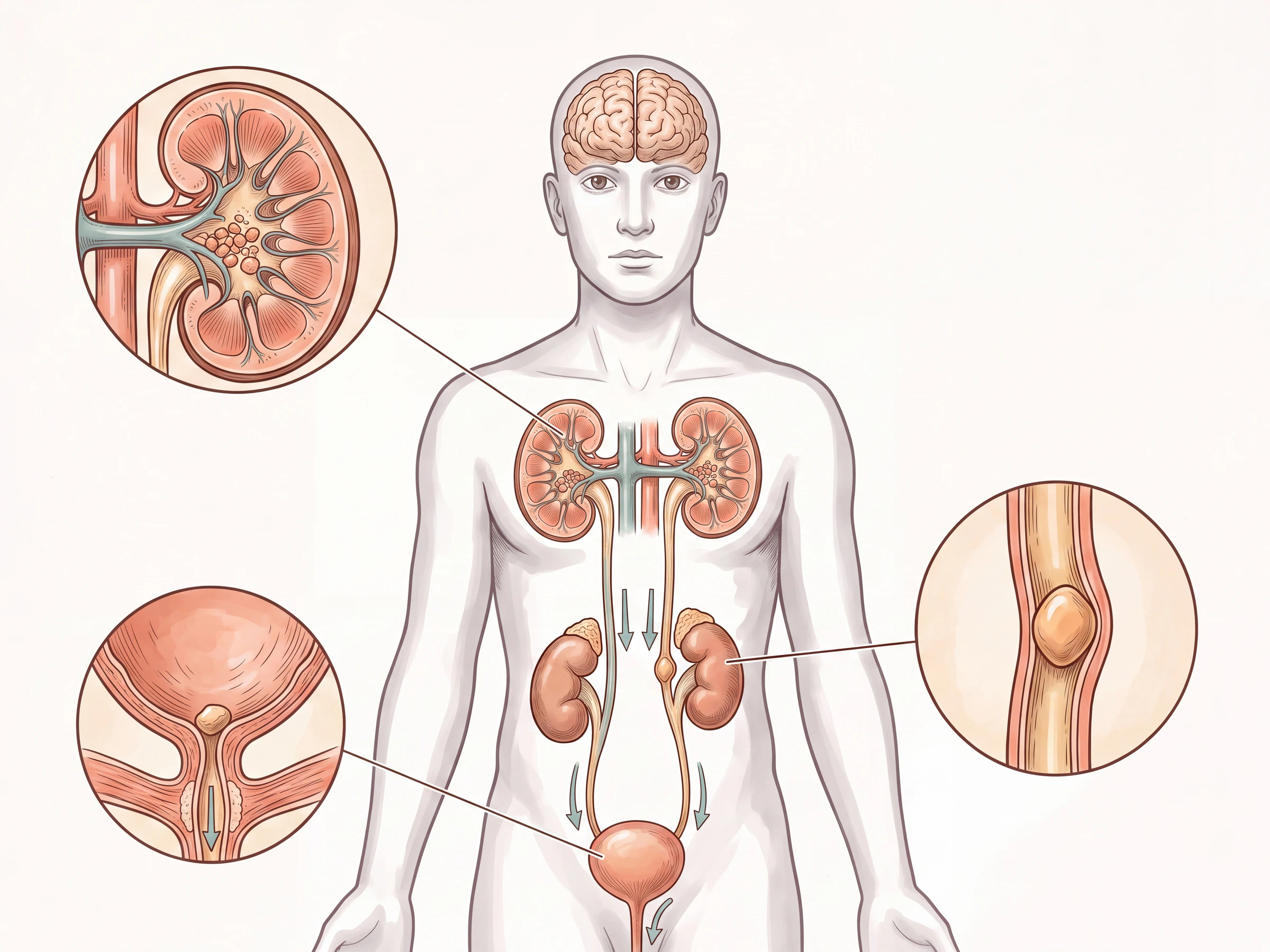
Urinary crystals can form stones, causing severe flank pain or obstruction. Recurrence prevention depends on appropriate fluid intake and stone type.
Summary before reading further
What is this topic, and why does it matter?
Urinary stones form when substances become concentrated and crystallize. Size, location, and obstruction determine symptoms and treatment.
Stone analysis, urine and blood tests, and imaging help identify the cause more precisely than broadly avoiding foods. Prevention differs according to the type of urinary stone.
Health glossary
- CT and MRI
- CT uses X-rays, while MRI uses magnetic fields and radio waves. The choice depends on the organ and clinical question.
What happens in the body?
Explain the mechanism step by step.
Urinary stones have different compositions and causes. Stone analysis and urine testing can guide prevention more precisely than broadly restricting foods yourself. More fluid helps many people, but those with heart or kidney disease should ask about an appropriate amount.
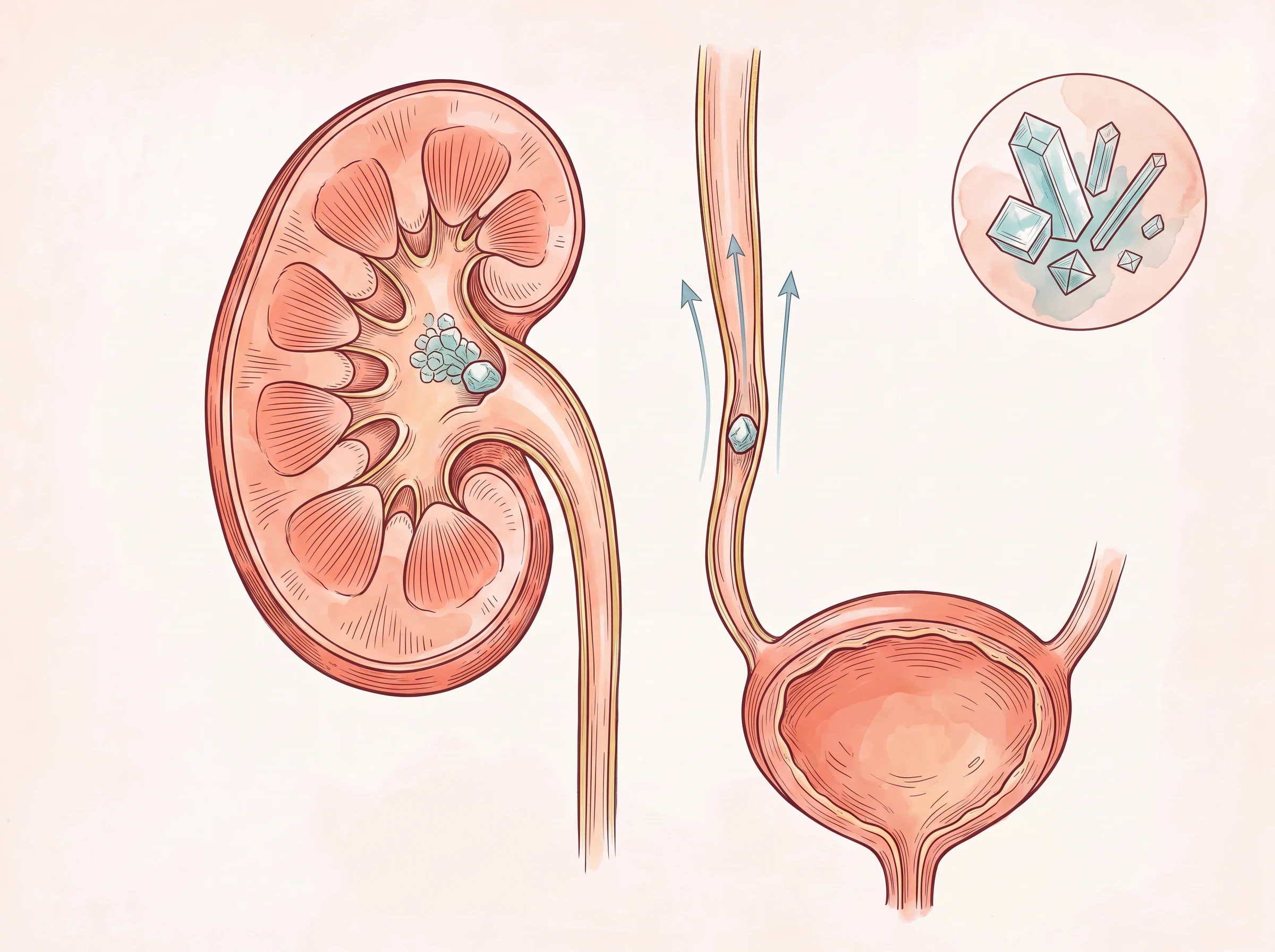
concentrated urine
Too little fluid or excess stone-forming substances allows crystals to form in the kidney's collecting spaces.
The crystals form into stones.
Crystals grow according to the balance of calcium, oxalate, uric acid, citrate, and pH.
Ureteral blockage
Pressure in the ureter and backed-up urine can cause pain and nausea.
Values or criteria that you should know
Stone size only partly predicts whether it will pass. Location, obstruction, infection, and kidney function are more important for care decisions.
Some small stones can pass on their own. But fever combined with urinary tract obstruction is an emergency even if the stone is not large.
Stone size
Diameter from CT or ultrasound
- Reference range
- Stones less than 5 mm are more likely to pass on their own. But it's not guaranteed.
- You should make an appointment for an evaluation.
- Stones measuring 5–10 mm need assessment of their location and progress. Stones larger than 10 mm are less likely to pass on their own and often require discussion of a procedure.
- Should be evaluated urgently
- Having one kidney, being unable to urinate, fever, chills, or uncontrolled pain warrants urgent assessment regardless of stone size.
Urine volume targets for stone prevention.
Daily urine target
- Reference range
- Stone-prevention guidance commonly aims for at least about 2.5 litres of urine daily, unless individual restrictions apply.
- You should make an appointment for an evaluation.
- Spread fluids throughout the day, adjusting for sweat, weather, and results of a 24-hour urine stone-risk assessment.
- Should be evaluated urgently
- People with fluid restrictions for heart or kidney disease need an individual fluid target from their doctor. General targets may not apply.
Causes · Symptoms · Examination · Care
See important information in one place.
Causes and related factors
- Low fluid intake, hot weather, and high sodium intake.
- Family history of obesity, gout, and intestinal disease
- Urinary tract infection or certain medications
Common symptoms
- Pain in the side that radiates into the lower abdomen or groin.
- Nausea, blood in the urine or frequent urination
- Fever with urinary pain or reduced urine output needs urgent assessment.
How do doctors check?
- Urine, blood, and kidney function tests
- Non-contrast CT or ultrasound, selected for the situation.
- Stone analysis and a 24-hour urine assessment may be needed for recurrent stones.
Start taking care of it systematically.
- Follow fluid advice suited to your conditions and monitor urine colour.
- Reduce sodium, avoid cutting out dietary calcium yourself, and tailor changes to the type of urinary stone.
- Go to hospital for fever, chills, uncontrolled pain, persistent vomiting, or stone symptoms when you have only one kidney.
Important things you should know
Keep these points in mind.
Colicky flank pain may spread to the lower abdomen.
Pain often comes in waves and may occur with nausea, burning urination, or blood in the urine.
Examination helps identify the location and blockage.
Your doctor may use urine, blood, ultrasound, or computed tomography (CT) tests as appropriate.
Treatment depends on size, location, and infection.
Some small stones pass on their own; larger stones, obstruction, or infection may require a procedure.
The recurrence prevention plan must be based on the type of stone.
Sodium, animal protein, oxalate, and calcium have different roles in stone formation. Do not eliminate calcium or several food groups without advice.
Daily food and care
Fluid intake and stone type guide recurrence prevention.
- Spread fluid intake through the day to avoid consistently dark urine, unless your doctor has prescribed a fluid limit for heart or kidney disease.
- Reduce sodium and processed foods. Adjust animal protein or oxalate according to stone type, and maintain appropriate dietary calcium rather than avoiding it entirely.
Read on to understand.
Read on for complete information on health and products.
Main references
