Easy-to-understand health information
Age-related macular degeneration
Macular disease affects central tasks such as reading and driving and may be unnoticed early. Follow eye-examination advice for your risk.
Summary before reading further
What is this topic, and why does it matter?
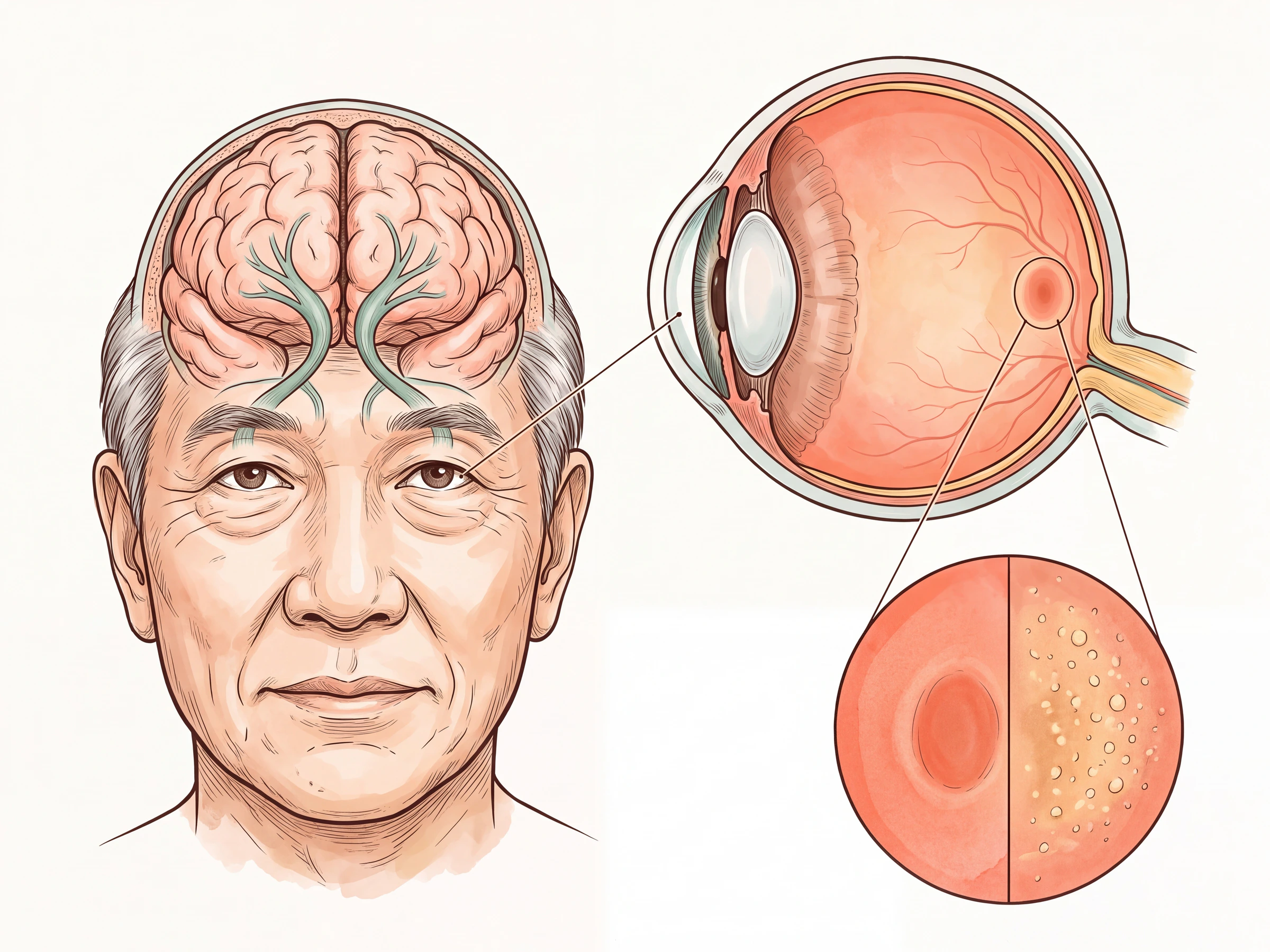
AMD affects the central retina, causing central blur, dark areas, or distorted lines while peripheral vision may remain.
Dry AMD usually progresses more gradually, while wet AMD can change rapidly. Treatments and specific supplement formulations have stage-dependent uses, so an ophthalmologist should assess suitability.
Health glossary
- AMD
- Age-related damage to the macula that blurs or distorts central vision, while peripheral vision may remain.
- AREDS and AREDS2
- A vitamin and mineral formulation studied in selected AMD stages. It is not appropriate for everyone or a replacement for eye examination.
What happens in the body?
Explain the mechanism step by step.
AMD affects central vision more than peripheral vision. Newly distorted straight lines or a missing central area can indicate wet AMD and need prompt assessment.
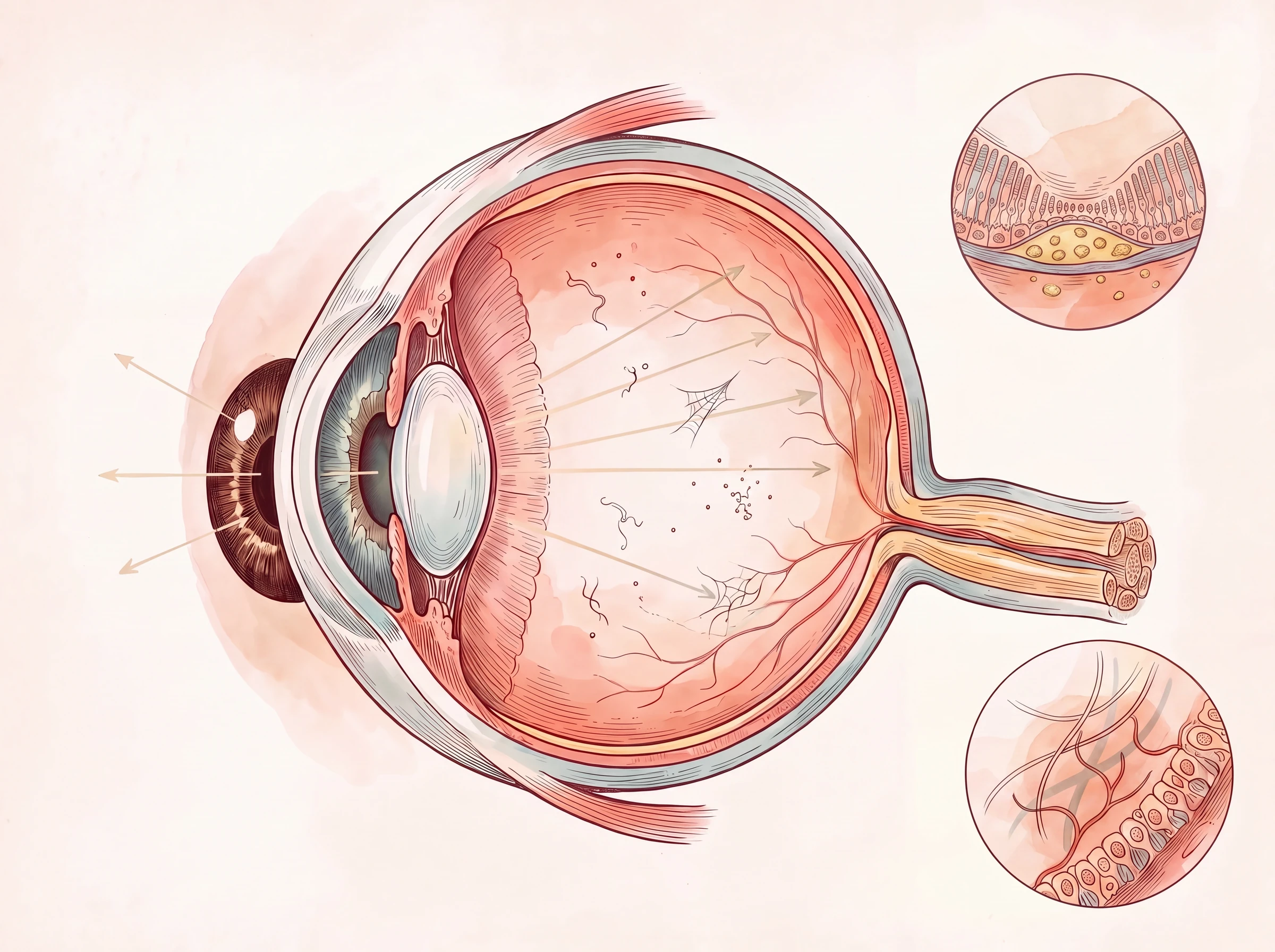
Waste accumulates under the retina.
Drusen beneath the retina are associated with changes in macular function.
The macula is thinner.
Photoreceptors and their supporting layer deteriorate, gradually reducing central visual detail.
Plasma leakage occurs in some people.
Abnormal new vessels can cause rapid retinal swelling, bleeding, and distorted vision.
Values or criteria that you should know
New distortion of straight lines deserves prompt attention; do not wait for further vision loss.
AMD affects central vision. An eye examination and OCT distinguish dry from wet AMD; wet AMD requires prompt treatment.
Amsler grid
Test one eye at a time with the same reading glasses.
- Reference range
- Grid lines should appear straight, without new missing areas compared with your usual view.
- You should make an appointment for an evaluation.
- Contact an ophthalmologist promptly for newly distorted lines, central blurring, or missing areas of vision.
- Should be evaluated urgently
- Sudden central vision changes may indicate wet AMD. Do not wait for a routine appointment.
Visual prescription
visual acuity of each eye
- Reference range
- Good visual acuity does not rule out early AMD.
- You should make an appointment for an evaluation.
- Compare with previous results and your ability to read and recognise faces.
- Should be evaluated urgently
- Sudden vision loss or a curtain-like shadow requires urgent assessment for retinal problems.
Causes · Symptoms · Examination · Care
See important information in one place.
Causes and related factors
- Age and family history
- Smoking is an important modifiable risk factor.
- High blood pressure, abnormal lipids, and excess weight also affect risk.
Common symptoms
- Difficulty reading or recognising faces.
- Straight lines appear distorted or the center of the image is blurred.
- More light may be needed while peripheral vision generally remains.
How do doctors check?
- Examine the retina after dilating the pupil.
- OCT assesses the macula and any fluid accumulation.
- Retinal angiography or specialised imaging may be used when wet AMD is suspected.
Start taking care of it systematically.
- Stop smoking and manage blood pressure and diet.
- Have your eyes examined and use the Amsler chart as recommended by your ophthalmologist.
- Contact an ophthalmologist promptly for newly distorted vision or a missing area in the centre.
Important things you should know
Keep these points in mind.
Central vision is affected
Reading, recognising faces, or seeing fine detail may become difficult even when peripheral vision remains.
Distorted straight lines are an important sign.
Any new changes should be reported to the ophthalmologist immediately.
The AREDS formula is not suitable for everyone.
Use only for the recommended duration after checking ingredient-related risks and contraindications.
Daily food and care
Start with manageable everyday steps.
- Stop smoking, eat a varied diet including leafy greens, and manage blood pressure and lipids as part of your overall care plan.
- Do not start high-dose eye supplements yourself. Have an ophthalmologist establish the AMD stage and suitable formulation first.
Read on to understand.
Read on for complete information on health and products.
Main references